It is becoming more and more clear to me that my initial intuitions were right about Miles Mathis's work. There's actually been an organization for the last 20 years that has been saying many of the same points. I still highly recommend Mathis’s work for historical and social perspectives and intuitive insight. Here I will present some other writings I have found, which I believe provide enough evidence for anyone to begin to question the mainstream acceptance of Einstein’s Special Relativity, which postulates that space itself is curved.
I do not claim that anyone has disproved the idea of curved space. I just claim that the idea of curved space is but one possibility among several. Other theories agree with the same degree of accuracy to the experimental evidence. Light moves too fast for any of the experiments performed to date to determine which theory is best.
Special Relativity grew directly out of the assumption that observers in separate frames of reference will interact with the same rays of light. Another possibility is Curt Renshaw's Radiation Continuum Model, which theorizes that light is emitted in a continuum of velocities. In this theory, observers in separate reference frames interact with separate rays of light, so that the only light they see would be light that is travelling at speed "c" of 186,000 miles/sec as James Clerk Maxwell's set of equations predicts.
The best evidence that theories like Renshaw's, which are currently shut out almost completely from American universities, deserve more attention, is probably the words of Nikola Tesla written in 1932, 27 years after Einstein first published the theory:
I hold that space cannot be curved, for the simple reason that it can have no properties. . . Of properties we can only speak when dealing with matter filling the space. To say that in the presence of large bodies space becomes curved is equivalent to stating that something can act upon nothing. I, for one, refuse to subscribe to such a view. - http://www.tfcbooks.com/tesla/1932-09-11.htmTesla and Einstein had no grudges. Einstein actually sent Tesla a birthday card in 1931. Tesla simply felt that Special Relativity was wrong, and held this view until his death in 1943. Granted Tesla was somewhat of a showman who enjoyed giving entertaining quotes to newspaper journalists, but he would have personally gained much more media attention by connecting himself to the media storm generated by Arthur Eddington’s alleged 1919 confirmation of Einstein’s theory. Unlike other claims Tesla made to the media of his outlandish experimental achievements, his theoretical disagreement with Special Relativity is unquestionably genuine.
Tesla almost unquestionably understands electromagnetism as well as anyone in history. Does anyone else find it odd that the man who understood electricity better than Edison and was the first to invent the radio, rejects the mainstream theory of how electromagnetic waves travel through space? There seem to be two possibilities. 1. Tesla is wrong, and just got lucky with his (multiple, groundbreaking) inventions. 2. Tesla is right, and the mainstream theory is wrong.
What about all the experimental verifications of Einstein's theory though?
Experimentally "proving" the accepted theories of mainstream academia is the name of the game in theoretical scientific research, today, so many alleged experimental verifications of special and general relativity have been written. In researching this topic, I was surprised to learn that the speed of light was actually first discovered and measured in the 1600's, by observations of the delayed intervals in the eclipses of Jupiter's moon, Io. We have known about the problem of light's finite speed for nearly 350 years, but it is only in the last 150 that anyone has paid it any attention! It turns out the speed of light is so fast, that we can ignore it and pretend it is instantaneous when predicting things here on earth. Some engineers have claimed that relativity is used in GPS satellites. But in practice, as is admitted by the GPS.gov website, they do not.
As crazy as it seems to think that mainstream science could get something like this wrong for coming up on 100 years, all the alternatives I have explored seem crazier.
Mathematically the problem is simple to describe. The point of contention is the definition of "motion" in the fundamental equations of electro-dynamics (velocity in the Lorentz Force equation, F = qv x B; current in Faraday’s law of induction and the Biot-Savart law.) The question is "velocity relative to what?” or, equivalently, “from whose perspective is the flow of the current to be measured?” (For more, see this page.) Equivalently, in regards to Maxwell’s equations, we could ask “should the derivatives in Maxwell’s Equations be partial derivatives with respect to time, or total derivatives with respect to time and motion?"
Explaining the history of why this question was never resolved is much more complex. First we must discuss the historical context out of which Einstein’s Special Relativity arose.
The story starts with James Clerk Maxwell, who formulated the first system of equations to accurately describe the interaction between electricity and magnetism.
The original significance of Maxwell’s equations, first published in 1861, is that it predicts that electromagnetic waves propagate at the speed of light, suggesting that light itself is just one of many forms of electromagnetic radiation.
During the 1820s-60s when these laws were first being formulated, the question of relative velocity was a non-issue. For any real experiment the ground, i.e. the motion of the earth, is the obvious choice of reference frame, so the question “velocity relative to what?” would have been too trivial to ask.
Maxwell believed that electromagnetic waves traveled in the absolute frame of a luminous ether. Therefore he, and most other scientists of his time, believed that the velocity between the earth, and the ether through which electromagnetic waves travelled, should be detectable by a sensitive enough experiment.
Thirty years later, after repeated experiments failed to detect the ether wind, physicists began to be at a loss for a workable explanation for how electromagnetic waves travel.
This question of “relative velocity” has become so ingrained in the fabric of mainstream physics today, that books will claim, as this one does,

“There is no way in which the ideas of ‘fixity’ or ‘motion’ can be ascribed to a field. The velocity u in the Lorentz formula is not ‘velocity relative to the field’ but ‘velocity relative to the observer’; for another observer with relative motion, E, B, and u would be different, yet in such a way to make F (the Lorentz force) the same.”Pg. 6 of my second-year college physics textbook makes the same argument:
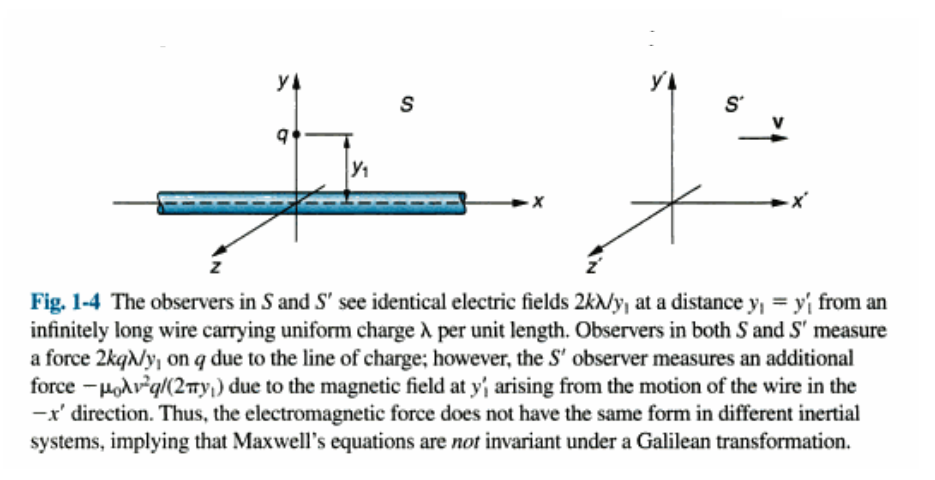
As if the situation where observers have different velocities is an everyday occurrence while conducting scientific experiments! Can you imagine being in a laboratory trying to take measurements from two frames of relative motion? The vast majority of all scientific experiments have been observed in the reference frame stationary to the laboratory building.
So how did the question of “velocity relative to what?” become so ingrained in the syntax of of 20th century physics, given that it is in actuality quite irrelevant to physics?
When the Michelson-Morley experiment failed to detect the expected “ether wind,” physicists were ready to accept almost any explanation. Lorentz tried to preserve the ether concept while also rationalizing the null results of the experiments.
Curt Renshaw writes:
It is important to consider the context of Lorentz's work. Faced with the results of the Michelson-Morley experiment and with the incredible success of Maxwell's equations, Lorentz had to find a way to reconcile the two. The Lorentz transformations allowed the preservation of the form of Maxwell's equations in any inertial frame of reference while still supporting the results of the Michelson-Morley experiment, which showed that the "medium" of light propagation (the aether) was not dragged along by the earth. The Lorentz transformations, developed as a means to reconcile the unexpected results of the Michelson-Morley tests, predict that lengths should contract and clocks should slow down for a reference frame in motion. - http://renshaw.teleinc.com/papers/german1/german1.stmLorentz used Heaviside's version of Maxwell's Equations, which use partial time derivatives rather than total time derivatives, inadvertently implying motion of all the equations to be relative to the observer.
This makes sense given that the ether reference frame is for the electromagnetic waves being emitted by moving electric charges, and not the motion of the charges themselves, which is the motion involved in all the equations of classical electromagnetism. The current is obviously moving relative to the ground. The idea that the current could be measured from observers moving at different velocities would never have occurred to Faraday, Maxwell, Heaviside, or Lorentz.
Renshaw explains:
[T]he initial assumption of the existence of an aether led to more and more corrections to the theory to explain continually improved experiments. In the end, Einstein did away with the aether, and was left only with the "corrections" to Galilean theory. - http://renshaw.teleinc.com/papers/fizeau/fizeau.stmMath has really always been about creating simplifying models of the world. Models that can be expressed as numbers, the most abstract of words, stripped down of all content so that they can be manipulated by preset rules and formulae. For better or for worse, numbers standardize our reality.
Lorentz tried to preserve the ether concept while also rationalizing the null results of the experiments. Lorentz realized that the existence of the ether could be saved if he just assigned different numbers to length and time. Thus, the Lorentz transformations were quickly adopted to preserve the ether concept.
Einstein convincingly denied the ether concept. Until Einstein, physicists assumed that a wave theory required a medium of traversal. Just as sound waves are the vibration of air molecules, so too light waves should be the vibration of some other analogous material, which was assigned the name “ether.”
But if Einstein was wrong, why was he such a phenomenon? There are three main reasons that I can see.
1. First and foremost, he was a brilliant conceptualizer, whose theoretical abilities surpassed that of Lorentz and most of his other contemporaries.
2. He did away with problem of identifying the ether, which finally allowed experimental physicists to turn their attention elsewhere.
3. As this MIT website and paper explain, he happened to come along at the right time and place in history to benefit from key social and technological currents.
Andrija Radovió writes of Special Relativity:
“We can ask ourselves how it is possible that so many things have so wrong explanations in contemporary official science. Our scholar system gives us illusion that we have explanation for all phenomena and that we can handle and control everything in the nature, but actually this is not true. lt seems that every scholar system has intention to fill any available part of the students’ mind with some data. If there are not enough facts, fictions are welcome too. We could remember the ancient Roman physician Galen who wrote 25 fat Medicines books full of... nearly nothing except instrumentations’ description. ... How did we come into the same situation? We should notice that at the time when the first modern car appeared on the streets (last decade of 19th century and first decade of 20th century) complete conceptual development of electricity was nearly finished. Polyphase currents were already invented altogether with asynchronous motors and generators that were widely used. Systems for AC electrical networks’ synchronizations, electric trains, tramways, electric cords in most apartments and houses altogether with electric lighting were existing even in small cities in Europe and America in those times. We should imagine situation where tramways, electric and steam locomotives were running together with horses running on streets. ... Then, an invasion of petrol combustion motors happened which retarded development of electrical machines and appropriate theoretical concepts including electromagnetic theory too. All blunders of electromagnetic theory were frozen waiting for some good reason to be defrosted. We are witnesses that we have not had real progress and that we have just been pushing pistons by hot gases and shaking magnets near wires for more than a century and that our almighty theories cannot predict nearly anything new.Some know, at least.
“Einstein theory is actually an excellent compilation of theories and hypothesis of 19th century’s physics which was much better than we are willing to admit to ourselves. Einstein was a good pupil that appreciated his predecessors and he did not distrust in their science. He derived equations that are able to yield pretty accurate results although the equations are apparently based on previous and inaccurate theories. If he tried to reject these theories as false ones he would lose legality of his brand new theory and then it would never be accepted. He had to reject teaching of Faraday (l), Maxwell (II) and Lorentz (lll) to be right and this would be very bad marketing for his theory.
“We cannot blame Einstein for that. He just did one terrific job - he harmonized electromagnetic theory and classical mechanics, i.e. he harmonized theory of operation of Faraday Wheel with results of mass dilation. But, we know now that classic electromagnetic theory is not quite correct and thus it could not be done with perfect accuracy.” - http://www.andrijar.com/therel/index.html
Curt Renshaw provides comprehensive analysis of the most prevalent alleged experimental confirmations from the last 80 years at his website. For example, he convincingly explains the effect of mass-increase as an apparent increase due to "the way in which mass is determined in a particle accelerator," not an actual increase the amount of physical mass of the particles.
Indoctrination is not an isolated problem in the operation of science today. Fortunately, due to the tremendous capacity of computers to share information for free, awareness seems to be growing. As Nobel-prize winner Randy Schekman has recently pointed out, the ignorance of obvious considerations is a testament to the indoctrination prevalent in mainstream academia.
Some of mainstream theory can be preserved by simply changing the partial derivatives in Maxwell’s equations to total derivatives, as explained by Petrovic Banko.
These three seemingly independent papers (all written by authors of different nationalities) all propose that Special Relativity can be discarded if total time derivatives are used instead of partial time derivatives in Maxwell’s Equations.
http://www.angelfire.com/sc3/elmag/ - Petrovic Banko. Nikisc, Montenegro
http://arxiv.org/pdf/hep-th/9608038.pdf - Andrew E. Chubykalo and Roman Smirnov-Rueda. Zacatecas, Mexico
http://citeseerx.ist.psu.edu/viewdoc/download?doi=10.1.1.172.7269&rep=rep1&type=pdf - Parry Moon, Domina Eberle Spencer, Arian S. Mirchandaney, Urea Y. Shama, and Philip J. Mann. NE United States
Renshaw takes a different approach, which appears equivalent. He defines all motion with respect to a stationary object, such as a current-carrying wire, so that different observers will not be using different values for velocity. It seems far simpler to use the total time derivatives instead, as they have they allow for velocity to be measured by observers in their own reference frame.
As far as I can tell from reading the actual paper, Maxwell was using the total derivative for Ampere’s Law, instead of the partial time derivative as it is written by the mainstream today, but other papers I have read say Maxwell was using partial derivatives. It is largely irrelevant however, as Heaviside, whose use of 1890s mathematics notation which had not yet been developed when Maxwell was writing in the 1860s, reduced the number of equations from 20 to 4 and became the standard preferred version. Heaviside replaced the total derivative with the partial derivative because at the time, it would have been nonsense to measure the change in any reference frame other than the ground, so Heaviside “simplified” the math by using partial instead of total derivatives.
